The Mitsotakis Paradox: Strong Growth, Weak Governance
The Mitsotakis Paradox / Strong Growth, Weak Governance
The Mitsotakis Paradox / Strong Growth, Weak Governance
A Turning Point?
Greece has left the worst of the crisis behind, but it has not resolved the issues that most undermine its political stability: an economy that distributes its benefits unevenly and an institutional system under scrutiny. This two-pronged challenge now haunts Prime Minister Kyriakos Mitsotakis. Greek journalist Nick Malkoutzis notes that, while macroeconomic indicators are holding up, social unrest and a string of scandals threaten to bring the Greek conservative leader’s tenure to an end.
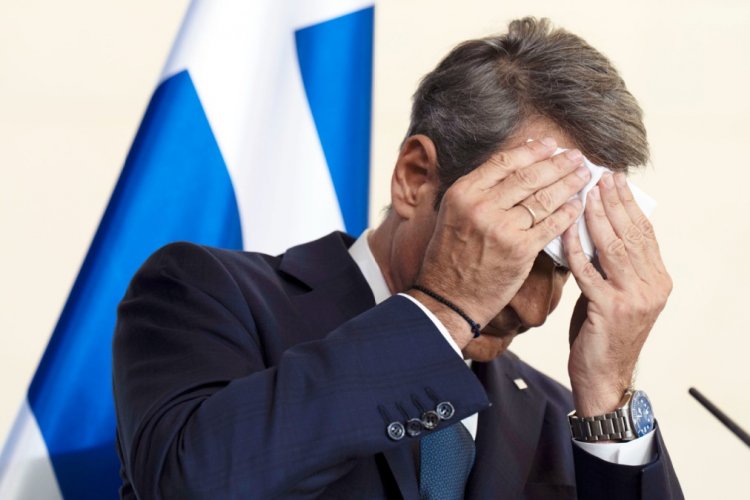
To many outside observers, Greek Prime Minister Kyriakos Mitsotakis appears to be a model leader. He has guided the country toward economic recovery, driven a digital transformation, launched a major upgrade of defense capabilities, strengthened diplomatic alliances, and improved the country’s standing in Europe to the point that his finance minister now chairs the Eurogroup, the very body that once subjected Athens to years of criticism and fiscal pressure.
Inside Greece, however, many see a very different picture of this 58-year-old center-right politician. They believe that the growth recorded during his seven years in office has benefited only a narrow segment of society and that the foundations are not being laid for a sustainable recovery — one that would finally banish the ghosts of the 2009-2018 depression.
Another factor tarnishing Mitsotakis’s domestic image is the steady flow of scandals that suggest his government has little respect for the rule of law and even less willingness to be held accountable when it comes to structural failures, corruption, or abuse of power.
"Mitsotakis, who won comfortable majorities in the 2019 and 2023 elections, now appears unlikely to secure a third consecutive victory"While doubts about the quality of Greece’s economic recovery have fueled disillusionment, the scandals have shattered trust. Mitsotakis, who won comfortable majorities in the 2019 and 2023 elections, now appears unlikely to secure a third consecutive victory, which would be unprecedented. Even within his own party, New Democracy (ND), questions are emerging about whether he remains the most suitable person to lead the conservatives - and the country.
Uneven recovery
With the exception of the pandemic year, the Greek economy has grown every year since 2017, and that growth remained solid in 2024, with real GDP rising by around 2.3%, well above the EU average. The country has clearly moved beyond the crisis years, when it lost a quarter of its output, but it is important to stress that the recovery remains uneven.
The real estate sector -driven by foreign demand and "golden visa" schemes- continues to dominate investment, while capital formation in knowledge- and technology-intensive sectors lags behind. Labor productivity remains below the EU average, underlining the structural nature of the gap.
Export performance has improved, but Greece still posts a sizable current account deficit. Unemployment has fallen dramatically from its crisis peak of nearly 28% to below 10%, one of the sharpest labor-market turnarounds in Europe. Even so, Greece still records one of the lowest employment rates in the euro area. Skills mismatches, limited mobility, and wage structures that discourage participation continue to weigh on labor-market performance.
"Those outside booming sectors such as tourism, real estate, and information technology feel excluded from the economic recovery"For many households, the recovery still feels distant. Low wages and rising living costs — amplified by a property market inflated by cash-rich foreign buyers — have left those outside booming sectors such as tourism, real estate, and information technology feeling excluded from the recovery. The acute uncertainty of the crisis years may have faded, but economic security remains fragile for a large share of the population.
Institutional decline
Beyond the economic indicators, the recovery has been uneven in an even more damaging sense: growth has not been matched by stronger governance. If anything, Greece’s institutional resilience appears weaker than during the crisis itself. Civil society groups and international organizations continue to raise serious rule-of-law concerns, especially regarding the justice system, media freedom, and accountability mechanisms.
"Trust in core institutions -the courts, political parties, and Parliament- has fallen to some of the lowest levels in the EU"The government has repeatedly faced accusations of obstructing full parliamentary or judicial scrutiny of major cases, including the country’s deadliest rail disaster, the Predator spyware affair, and the farm-subsidy fraud scandal. In an environment where transparency appears compromised and checks and balances seem fragile, public trust has eroded. Trust in core institutions -the courts, political parties, and Parliament- has fallen to some of the lowest levels in the EU, reinforcing the sense that democratic safeguards are weakening even as the economy grows.
The three major scandals that have come to light under the center-right government remain highly sensitive issues. The trial over the 2023 train crash, in which 57 people were killed, recently began amid intense controversy. The families of the victims, many of them young, have consistently accused the authorities of a cover-up and of interfering in the judicial process.
The surveillance scandal, in which dozens of politicians, journalists, military officers, and business figures were spied on, has also returned to the spotlight. In February, an Athens court found Tal Dilian guilty -the former Israeli soldier who founded Intellexa, the consortium behind the Predator spyware- along with three associates, for illegally accessing personal data through the 2020-2021 wiretapping operation.
Last month, however, Dilian issued a statement to the Greek media insisting that his company "only provides spyware to governments and law enforcement agencies." That claim directly contradicts the government’s long-standing defense that Predator was operated by private actors rather than by the National Intelligence Service (EYP), as opposition parties, media outlets, and several victims have argued.
"More than twenty serving and former New Democracy MPs -including ministers- have been implicated in what appears to be a systematic fraud"Mitsotakis’s position has become even more precarious because of the latest developments relating to the alleged fraudulent disbursement of EU agricultural subsidies. After submitting an initial case file last year, the European Public Prosecutor’s Office (EPPO) has now filed two more. More than twenty serving and former New Democracy MPs -including ministers- have been implicated in the apparent systematic fraud involving the Greek subsidy agency OPEKEPE, which allowed farmers and intermediaries to obtain hundreds of millions of euros to which they were not entitled.
The investigation included lawful wiretaps of suspects, and material leaked to the media paints a picture of politicians and advisers routinely pressuring OPEKEPE to monitor, fast-track, or revisit subsidy files, at times with explicit references to the political cost. This is especially damaging for Mitsotakis, who has presented himself as a European-style reformer.
The prime minister’s defense, both in the subsidy case and in the train-crash case, has been to blame structural deficiencies that Greece has carried for decades. Opposition parties argue that this line no longer holds, especially given that Mitsotakis has been in power for seven years and that New Democracy has governed for a total of roughly twenty-five years since the fall of the junta in 1974.
What now?
PASOK, the socialist party that has long been New Democracy’s main rival, argues that the only solution is for Mitsotakis to call snap elections. He is unlikely to do so. Instead, he will wait and hope that his government can withstand the pressure of these scandals and make it to the end of its four-year term, before next summer.
"The erosion of trust has pushed Mitsotakis onto a path that does not lead to a clear parliamentary majority"ND still remains far ahead of PASOK in the polls. One of the most recent surveys suggested that ND is on track to secure more than 31% of the vote, while PASOK remains below 14%. Even so, the erosion of trust has pushed Mitsotakis onto a path that does not lead to a clear parliamentary majority. ND would need several more percentage points to govern alone. It now seems more likely that the conservatives will lead a coalition government, possibly with PASOK as the junior partner.
Speculation is growing over whether ND might consider replacing Mitsotakis, or whether a coalition partner might demand someone else as prime minister. Although such an outcome is far from certain, it would likely mark the end of Mitsotakis’s political career. Had Greece’s opposition parties not been so weak, he might not have survived this long given the seriousness of the scandals that have dogged his administration.







![Guardian Report: War prompts Europeans to switch holidays away from eastern Mediterranean [Greece]](https://www.mykonosticker.com/uploads/images/2026/03/image_140x98_69b6938c31776.jpg)



![Guardian Report: War prompts Europeans to switch holidays away from eastern Mediterranean [Greece]](https://www.mykonosticker.com/uploads/images/2026/03/image_705x436_69b6938c1c7ac.jpg)